

Suzuki e-ACCESS: Equipped with LFP battery with long life and strong performance, it is creating a stir in the EV market – suzuki eaccess lfp battery range performance india News18 Hindi
The popularity of electric vehicles is now increasing rapidly in India. Earlier, due to lack of information, people used to ask only how much distance can an electric scooter cover? Now it is also asked that how long will this battery last? The specialty of an electric vehicle is that its power lies not in its engine but in the battery. If we talk about the Indian market, Nickel Manganese Cobalt (NMC) and Lithium Iron Phosphate (LFP) are used here. Now most of the companies are giving priority to LFP battery technology.
One of these is Suzuki Motorcycle India, which has used LFP battery in its first electric scooter Suzuki e-ACCESS. This technology is a ‘game-changer’ for electric scooters. Know its specialty…
Features of LFP battery-
1. Long life and durable
LFP batteries give you twice to three times longer life. If understood in simple language, these batteries have the power to maintain their capacity even after being charged and discharged thousands of times. At the same time, performance of NMC batteries often starts declining after some time.
2. High heat resistance
There is a risk of overheating and fire with batteries. LFP batteries reduce this to a great extent. Their thermal stability is excellent, due to which the scooter remains safe even on long journeys or in hot weather.
3. Strong and reliable performance
The LFP battery is a little heavier and has less energy than the NMC, but it lasts longer and performs better. Therefore, it is best for riders who want strong durability rather than great range.
Comparison of LFP and NMC: Performance difference
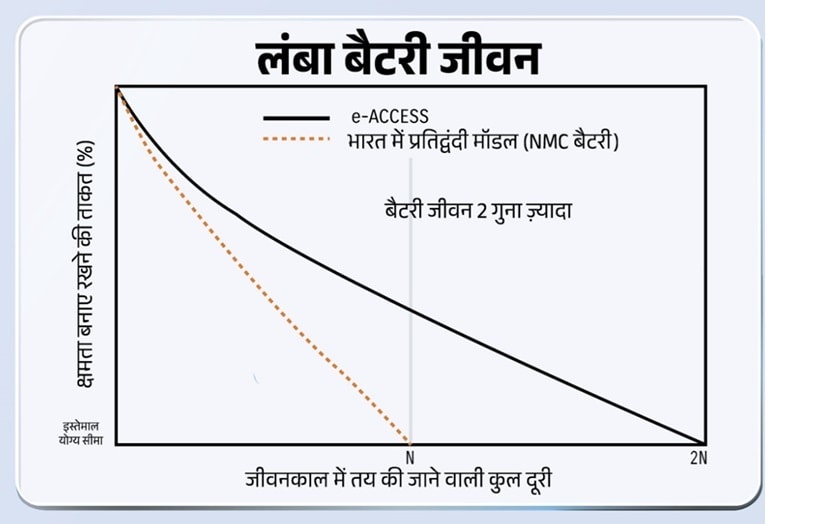
Long Battery Life Simulation
(X-axis: battery life | Y-axis: battery capacity retention)
This graph compares how much battery capacity drops over time between LFP and NMC batteries.
The dark blue line, which represents the LFP battery (used in Suzuki e-ACCESS), shows a slower and more steady decline in capacity over a longer period or multiple charging cycles. In contrast, the dotted line for NMC batteries (conventional) shows a steeper decline, indicating that it loses its capacity more rapidly as the number of charging cycles increases.
What does this mean for the customer? With LFP, the battery is expected to last twice the useful life and twice the number of charging cycles compared to NMC batteries. This means fewer replacements, lower long-term costs, and more peace of mind for the rider.
Why a Long-Life Battery Really Matters
Battery replacement is the most expensive part of EV maintenance, so long-term range is important. NMC batteries reduce range due to rapid degradation. However, LFP batteries (like the one in Suzuki e-ACCESS) have much higher Range Retention Power. The direct benefit of this is that the rider gets the same range over the years, which not only avoids the cost of battery replacement but also prolongs the overall life of the scooter.
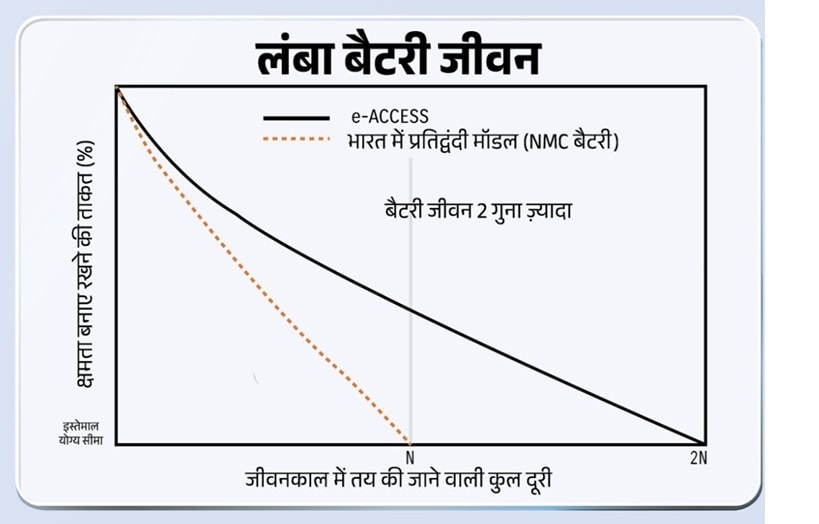
Long Term Range Simulation:
(X-axis: driving distance | Y-axis: range per charge)
This graph shows how NMC and LFP batteries perform over the long term. The red dotted line (NMC) may give more range initially, but as you drive more, its range reduces rapidly. On the other hand, the Suzuki e-ACCESS’s LFP battery (dark blue line) starts with a slightly lower range and maintains its range more strongly and consistently over time.
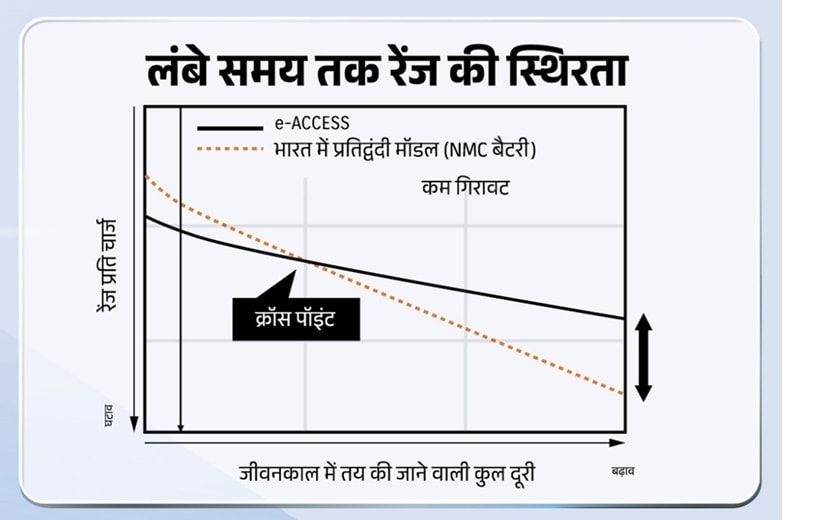
In simple words: NMC batteries may give you a little more range initially, but after about 1.5 years of daily use (about 80 km/day), the range of LFP batteries comes down to NMC levels. After this, the LFP maintains its range more strongly. So don’t just go for the initial range. Slow Capacity Degradation of LFP batteries ensures you can enjoy your full range for years to come.
Real-World Usage: Focus on practicality, not just on top range
Range is an important aspect of comparison, but it is not the only one. Given that most daily commutes in India are short and frequent, some manufacturers are focusing on improving actual performance rather than just maximum range. Suzuki has adopted the same strategy with e-ACCESS:
• It gives a practical range of 95 km on 3.1 kWh battery.
• According to statistics, the average Indian rider rides around 30 km daily, which means most people can ride the scooter for 3 days on a single charge. With this thinking, the scooter remains light and easy to ride and practicality also remains.
Designed for reliability and durability
Along with the chemical composition of the battery, its safety and thorough testing are also of utmost importance. In the Suzuki e-ACCESS scooter, the battery is rigidly integrated directly into the frame and protected in a powerful aluminum case. This system protects the battery from physical damage and reduces the risk of accidents like fire. Furthermore, each battery of e-ACCESS is put through rigorous tests such as drop, extreme heat-cold, vibration, water immersion, crush and puncture, to ensure that they are able to withstand any real riding conditions.
last words
LFP battery technology is a big change for electric two-wheelers. It is safe, durable and eco-friendly. Brands like Suzuki are adopting it. This is proof that India’s EV market is now moving towards more long-lasting and smart battery technology. In the times to come, scooters with LFP batteries could become a symbol of trust and stability on Indian roads.
(Disclaimer: This article is from Brand Desk. Please decide at your own discretion.)