


Most consecutive maiden overs in Test cricket: The great record of bowling 21 consecutive maiden overs…The bowler stopped the batsmen’s breathing, the record has been unbroken for 62 years.
Last Updated:
Most consecutive maiden overs in Test cricket: Whenever there is talk of the most ‘miser’ bowler in the history of cricket, the name of India’s Bapu Nadkarni comes at the top. On 12 January 1964, in the Test match played against England in Madras (now Chennai), he set a record which is unbreakable even today. Nadkarni made a world record of bowling 21 consecutive maiden overs, that is, England’s batsmen could not score a single run for 131 consecutive balls.
 Bapu Nadkarni holds the world record for bowling 21 consecutive maiden overs in Test cricket.
 New Delhi. Cricket is a game in which records are often made and broken. Sometimes the batsmen dominate the bowlers and sometimes the bowlers dominate the batsmen. But there is a name recorded in the history of Indian cricket who established such a great record of ‘not giving runs’ that the world was stunned. That name is- Rameshchandra Gangaram Nadkarni, whom the cricket world knows as ‘Bapu Nadkarni’. On January 12, 1964, the Corporation Stadium in Madras (now Chennai) was packed. The first match of the Test series was being played between India and England. The England team was batting in the first innings and Indian captain Mansoor Ali Khan Pataudi handed the ball to Bapu Nadkarni. Nadkarni was famous for his left-arm spin bowling and accurate line-length.
That day, something was going to happen on the field which had never happened before and had never been seen since. Bapu Nadkarni started bowling and then began an endless series of ‘maiden overs’, which tested the patience of the English batsmen. Bapu Nadkarni started bowling one maiden over after another. England’s batsmen Brian Kane and Ken Barrington were present at the crease, but Nadkarni’s balls had become like an unsolved puzzle for them. Over after over passed. 1, 5, 10, 15 and then 21 consecutive overs became maidens. His economy rate was only 0.15.
Bapu Nadkarni bowled 131 dot balls
This was no less than a miracle in cricket statistics. He bowled 131 consecutive dot balls. England’s batsmen were yearning for one run each, but Nadkarni’s length was so precise that it was difficult to touch the ball, let alone hit it. The surprising thing was that despite bowling 32 overs, he did not get a single wicket, but his bowling put such a break on England’s run rate that the entire team came under pressure. In this innings he bowled a total of 32 overs, out of which 27 overs were maidens. He spent only 5 runs in the entire spell.
Bapu Nadkarni was the magician of precise line-length.
It is said that Bapu Nadkarni used to place a coin on the pitch during net practice and would practice for hours so that each of his balls fell on the same coin. His hard work paid off in the Madras Test. He was such a disciplined bowler that it was said that if the batsman did not want to hit a shot, Nadkarni would not give him any chance to score runs. In today’s era, where the dominance of batsmen has increased due to T-20 and ODI cricket. Even today no bowler has been able to break this great record of Bapu Nadkarni. Bowling 21 consecutive maiden overs in Test cricket shows the mental strength and incredible control of the bowler.
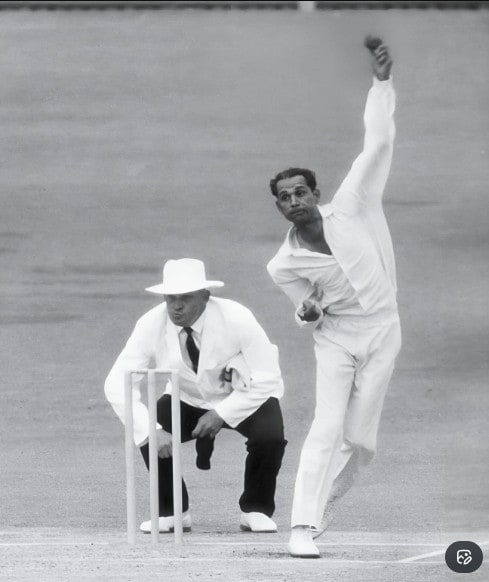
It is impossible to break the record that has been unbroken for 60 years.
Bapu Nadkarni played 41 test matches for India and took 88 wickets. Apart from this, he scored 1414 runs with the help of one century and seven half-centuries. Nadkarni has 500 wickets in his name in 191 first class matches. He has scored 8880 runs which includes 14 centuries and 46 half-centuries. But that spell of 1964 immortalized him forever. When he died in 2020, the entire cricket world paid tribute to him by considering him as ‘synonym of accuracy’. This story of Bapu Nadkarni teaches us that cricket is not just a game of strength, but it is also a test of patience, discipline and concentration. This record of his has remained unbroken for the last 62 years and perhaps it will be impossible to break it for many decades to come.
About the Author

Active in journalism for about 15 years. Studied from Delhi University. Interested in sports especially cricket, badminton, boxing and wrestling. Covered IPL, Commonwealth Games and Pro Wrestling League events. From February 2022…read more